Through Herstory, students craft memoirs that lead to social change.
At the Herstory holiday party, workshop participants from Adelphi and two local high schools shared their stories with family and friends.
by Ela Schwartz
The Campbell Lounge in Adelphi鈥檚 Center for Recreation and Sports is a fairly nondescript space, a straightforward, brightly lit meeting room with institutional chairs and tables that leaves nothing to the imagination. It鈥檚 here where Adelphi students majoring in English, social work and criminal justice along with their younger counterparts from Mineola High School and Cardozo High School in Queens are meeting for their last fall semester workshop run by the program.
The young writers take turns reading their selections. And as the workshop progresses, the utilitarian room fades and participants are transported from a backyard in India so inundated with fruit trees that its young author called it a 鈥渇ruit bowl,鈥� to a village in Italy where Jews were hidden during World War II, to a cafeteria where a young girl and her new friend survive the vicissitudes of middle school by collaboratively writing fantasy stories. Some authors reached back to early childhood and told stories that spanned years; one girl wrote about 10 life-changing minutes. Many topics were profound for young writers between 15鈥�21 years of age: emotional abuse, eating disorders, interracial dating, family conflicts and battling depression.
Under the guidance of Herstory workshop facilitator Silvia Heredia, the writers shared secrets, reinterpreted painful events as learning experiences and offered encouragement to one another. 鈥淲e鈥檙e interested in the journey, how stories help us understand bigger issues,” Ms. Heredia said.
As Charlotte Ring, a high school junior, wrote, 鈥淲e must learn solely from our experiences . . . for that is what forges one鈥檚 true self.鈥�
Erika Duncan, founder and artistic director of the , said the workshops give voice to the most isolated and vulnerable populations on Long Island, including those incarcerated in one of Long Island鈥檚 three jails or living in homeless shelters, gang-involved youth and women on disability and welfare.
She explained that bringing together the college and high school students creates a 鈥渞eciprocal mentoring chain. High school students who hadn鈥檛 considered college come to see it as a viable option, while college students become aware of issues affecting youth in their communities and inspired to become involved in social activism and community engagement,鈥� she said.
The Herstory project is cosponsored by the Ruth S. Ammon School of Education, the and .
鈥淔uture English teachers are learning about the students they will have in their classrooms,鈥� said Diana Feige, EdD, associate clinical professor in the . 鈥淣ow they know every student has a story, some of which are complex, and knowing this makes us sensitive to their needs.鈥�
鈥淗erstory workshops taught our students how reflective writing can be used as a tool to empower clients through a therapeutic process,鈥� Sergio Argueta, director of undergraduate social work, said, adding that the School鈥檚 innovative curriculum and extracurricular activities enable students to become highly qualified professionals in the social work field. 鈥淏ringing together future teachers, social workers and criminal justice providers enables them to work collaboratively and learn to complement one another.”
Jacqueline Galdamez, a junior majoring in social work, said, 鈥淓veryone writes from different perspectives. It鈥檚 useful to listen.鈥�
Herstory has a multifaceted relationship with Adelphi. In 2013, the organization was selected to participate in the program offered by the . In spring of that year, Herstory was chosen by the first cohort of Adelphi School of Social Work undergraduate students participating in , in which they awarded Herstory with a $10,000 grant.
Then Ms. Duncan asked Sergio Argueta, director of undergraduate social work, 鈥渋f he knew of an entry-level person whom he might recommend,鈥� she said. 鈥淗e replied, 鈥業 have the perfect person.鈥欌��
That perfect person was Amanda Hiltz 鈥�13, who is now the Youth and Justice program associate. She now cofacilitates workshops with women incarcerated on Long Island. Like all Herstory facilitators, Ms. Hiltz is working to craft her own memoir. She says this process of putting her own feelings and experiences into words will help her understand how to help her future clients express themselves.
Her role also entails advocating for policy change. She is part of a team that organizes ways to bring the stories written in the jails to conferences and events focusing on the torture of solitary confinement and the campaign, which aims to raise the age of incarceration in New York State to 18 so that juveniles are not in prison with adults, she explained.
鈥淭he stories go forth,鈥� Ms. Duncan added. 鈥淎nd a lot of these students will keep writing.鈥�
After the last workshop, Herstory participants held a holiday party where those who wished to shared their work with friends and family. No doubt all would agree with the closing sentences of high school sophomore Jasmine Lee鈥檚 story: 鈥淵ou are the wielder of the brush, the one with many colors. No matter how ugly or beautiful your pictures turn out to be, in the end it is still a masterpiece.鈥�
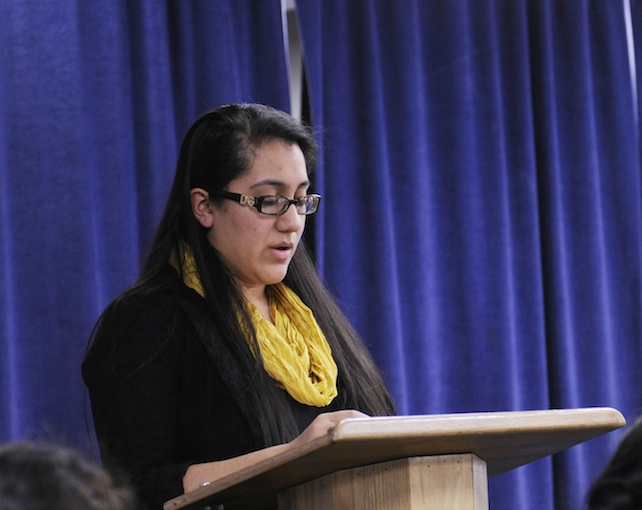 Jacqueline Galdamez, a junior in the School of Social Work, reads her story. |
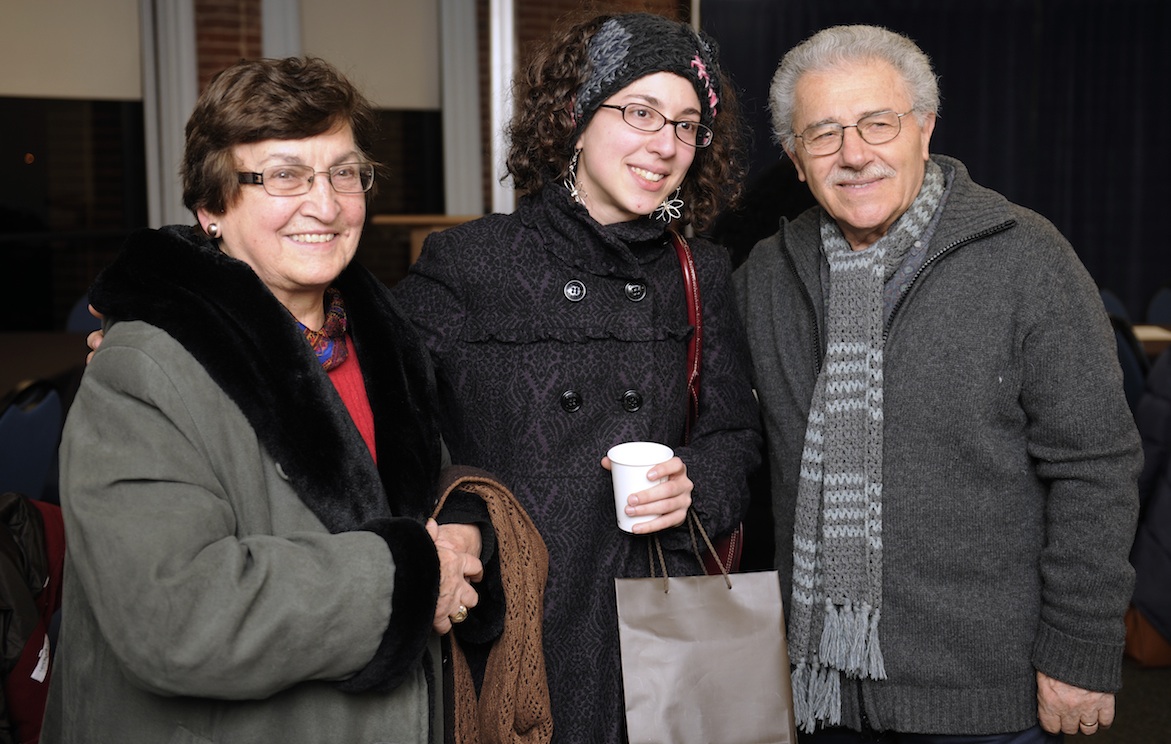 Sabrina Spotorno, a senior studying social work, was inspired by her grandparents from Italy. |
For further information, please contact:
Todd Wilson
Strategic Communications Director听
p 鈥� 516.237.8634
e 鈥� twilson@adelphi.edu