The School of Social Work is preparing students to meet the growing demand for social workers to serve older adults.
Taylor Herbert, M.S.W. ’07, with one of her clients at the Sid Jacobson Jewish Community Center.
Taylor Herbert, M.S.W. 鈥�07, LMSW, always knew she wanted to help people. She just wasn鈥檛 sure what population she wanted to serve as a social worker.
Intrigued by the growing need for social workers to help older adults, Ms. Herbert decided, in her final year of graduate school, to participate in a new program at the 茄子视频 School of Social Work: the .
After her field placements, including one at the she knew she鈥檇 found her niche. The SJJCC hired her right after graduation, and today she is the director of specialized senior services. Her role is to direct programs for seniors who are frail and/or at various stages of memory impairment, as well as a one-of-a-kind program for clients in their 30s through 50s with young-onset dementia. The SJJCC has also hired two Adelphi graduates straight out of HPPAE.
Philip Rozario, Ph.D, director of the and an expert on gerontological social work, pointed out that 鈥淭here is a serious shortage of trained professionals to deal with a growing aging population. At Adelphi, graduate students can lead the way in this expanding field.鈥�
According to government statistics, employment of healthcare social workers, which includes those working with the geriatric population, is projected to grow 27 percent from 2012 to 2022鈥攎uch faster than the average for all occupations, due to the aging of the baby boomers. Adults aged 90 and above are the fastest-growing demographic鈥攏early tripling over the past three decades and projected to more than quadruple over the next 40 years.
Dr. Rozario explained that any social work specialization has an elderly component. Older adults contend with addictions, AIDS and mental illness. They may have custody of a child through the foster care system, or be veterans, as Amanda Cruz 鈥�13, M.S.W. 鈥�14, experienced.
Ms. Cruz originally thought her social work calling was working with children. She decided to participate in HPPAE to 鈥渄iversify my r茅sum茅,鈥� as she put it. Her field placement was in the lock-down unit of a nursing home for veterans ages 60鈥�95 contending with post-traumatic stress disorder (PTSD) and other mental illnesses and behavioral problems. She oversaw a caseload of 鈥渆ight different people鈥斺�榙ifferent鈥� being the key word,鈥� as she put it.
And she said she鈥檚 thoroughly enjoyed the experience, enough to decide to change her career choice to geriatric social work.
She praises the instruction she received in HPPAE about the aging process, legal matters such as wills, power of attorney and advance directives, and her continuing education classes, admitting, 鈥淎ll my classes were so meaningful and practical in my internship.鈥�
Part of her internship included a needs-assessment project she completed with a fellow intern on conflict resolution among the veteran residents. The result was the formation of a group in which members learn social skills, a group that has continued even after Ms. Cruz鈥檚 internship ended.
For the future, 鈥淚鈥檓 going to stick with the geriatric population,鈥� she said. 鈥淚 enjoy being there for them, learning their histories, how life was different then from now, what they鈥檝e seen and what they need to put to rest.鈥�
Ms. Herbert has no regrets about her choice to work with older adults. 鈥淚 can鈥檛 believe I get paid to do this,鈥� she said. 鈥淚 love seeing seniors, who were unhappy when they got off the bus, go home with huge smiles on their faces. HPPAE was a fabulous opportunity. It got me where I am today. I would absolutely鈥�100 times over鈥攄o it again.鈥�
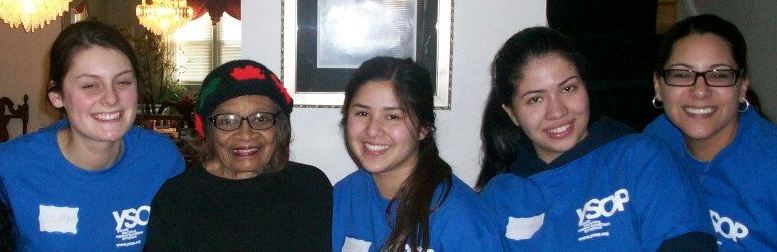
In 2013, Amanda Cruz ’13, M.S.W. ’14 (far right), and fellow Adelphi students participated in a Youth Service Opportunities project in Washington, D.C., where they worked with this senior citizen through the Age-in-Place, Seabury Resources for Aging program.
For further information, please contact:
Todd Wilson
Strategic Communications Director听
p 鈥� 516.237.8634
e 鈥� twilson@adelphi.edu