Associate Professor of Social Work CarolAnn Daniel assisted Haitians in preventing HIV and other sexually transmitted infections.
By Bonnie Eissner
Even before the devastating 2010 earthquake, Haiti had the highest HIV infection rate听in the West, outside of Africa, according to Adelphi Associate Professor of Social Work CarolAnn Daniel, Ph.D. The quake and its dire aftermath have only exacerbated the听situation. Dr. Daniel and a colleague, Carmen Logie, Ph.D., from the University of听Calgary, have spent the past year and a half working on two grant-funded programs听intended to support the most vulnerable Haitians and assist them in preventing HIV and听other sexually transmitted infections (STI).
This past May, Dr. Daniel and Logie completed a yearlong project to develop and test a听community health worker-delivered HIV/STI prevention program for 200 women living听in internally displaced persons camps just outside of Port-au-Prince, in L茅ogane, Haiti.听For the project, Dr. Daniel and her colleague developed a six-week psychoeducational听and sexual health program to encourage dialogue on such issues as STI and what puts听women at risk. They also created surveys to determine what the women knew about听HIV and STI and the individual, social and environmental factors that contribute to听infection before and after the education program. Dr. Daniel explains that, 鈥淐apacity听building was another important goal of the project, so we hired and trained 10听internally displaced women to run the groups and conduct the surveys.鈥� The project听was funded by $100,000 from Grand Challenges in Global Health and was the only听social research project鈥攐ut of 20鈥攖o receive a Grand Challenges grant.
For their second project, which began this past summer, Drs. Daniel and Logie received听$25,000 from the Canadian Institutes of Health Research to conduct a photo voice听project to, in Dr. Daniel鈥檚 words, 鈥渦nderstand HIV prevention priorities, barriers and听facilitators among young women and men 18鈥�24 in L茅ogane.鈥� The roughly 60 young听people who are participating in the project use instant cameras to document the people,听places and situations that put them at risk for STI. They then select the pictures that are听most meaningful to them and explain them in written or oral narrative. Dr. Daniel says听that the photo voice approach 鈥減uts people in charge of how they represent themselves听and their situation.鈥� She continues: 鈥淚t also allows the young people to become听competent participants in the research process鈥攂oth of which are very important to us,听given the negative folk narrative in the U.S. about people in Haiti.鈥�
Ultimately, Dr. Daniel intends to 鈥渄emystify the biosocial aspects of HIV.鈥� She听says, 鈥淗aitians are very clear that it鈥檚 their poverty and desolation that leads people to听do things that put them at risk鈥nce you work there, it鈥檚 not difficult to see it, you just听have to know how to listen to really get it.鈥�
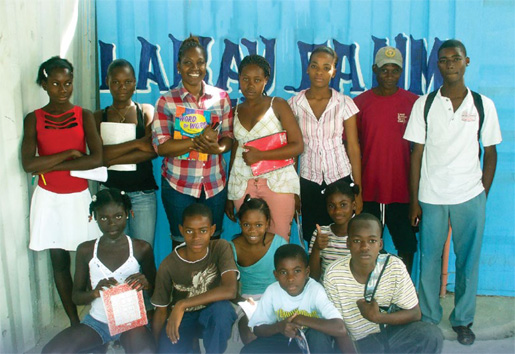
Young people in L茅ogane, Haiti, who worked with Adelphi Associate Professor of Social Work CarolAnn Daniel, Ph.D., on an HIV and STI documentation project
For further information, please contact:
Todd Wilson
Strategic Communications Director听
p 鈥� 516.237.8634
e 鈥� twilson@adelphi.edu