Michael Schroeck and Viktor Mayer-Sch枚nberger spoke about Big Data, it's meaning, it's uses and its future.
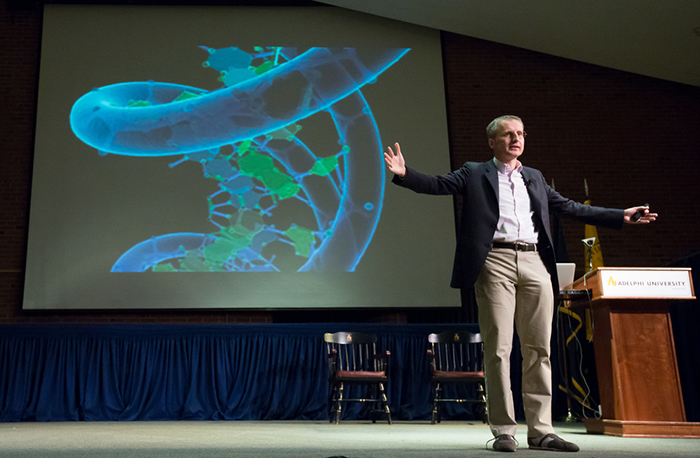
Big data is the collective and constant answer to one question: What is happening in the world right now? There is no why or how, no cause or effect, just the simple observation of the present.
Big data encompasses all, but how is that information collected? , partner/vice president, , and Viktor Mayer-Sch枚nberger, co-author of the current business best-seller , visited the Adelphi for separate lectures regarding the topic. Schroeck explained that his sector has never before experienced a coming together of so many information sources, including the cloud, mobile devices and social media.
Any and every kind of data can be and is collected. For example, Mayer-Sch枚nberger said:
- People buy lots of Pop-Tarts at Wal-Mart before a hurricane makes landfall.
- processes a couple of dozen petabytes, each equal to a million gigabytes, every day; 10 million photos are posted to every hour; an hour of high-definition video is uploaded every second to , which has 800 million users; and 500 million tweets are posted on every day.
- Used cars that have the fewest defects are orange.
鈥淚nformation is everywhere. How can we, as an industry, do a better job not just tapping the information, but refining it, analyzing it and turning it into something that鈥檚 very useful?鈥� Schroeck asked at his recent campus lecture. It鈥檚 the job of his department to tap into the world鈥檚 unrefined information and to figure that out. 鈥淭he world鈥檚 information doubles every 11 hours. Ninety percent of the world鈥檚 total information from the outset of history has been generated in the last two years, and it鈥檚 not going to slow down.鈥�
Mayer-Sch枚nberger used the telescope as an example. In 15 years, it has collected more than 200 terabytes of astronomical data. He explained that the 8.4-meter is slated to start sky scanning in 2016 and will collect those same 200 terabytes in about five days.
He cited two other examples:
- When, in 2003, the scientific world celebrated the first entire mapping of a single DNA sequence, he noted the achievement took 10 years and a billion dollars. Today, 13 years later, it can be done in two to three days and at a cost of less than a thousand dollars.
- It鈥檚 due to big data鈥攖he availability of massive amounts of data鈥攖hat scientists have discovered patterns in the vital signs of premature infants to predict, with a high degree of likelihood, the arrival of complications 24 hours before symptoms manifest.
鈥淲e鈥檙e datafying ever more aspects of human reality and then we extract value from it,鈥� Mayer-Sch枚nberger said, noting as one such item that could turn human reality into a constant stream of information. 鈥淭o be able to datafy the human gaze鈥攖hat is, to know, to find out and to be able to observe what human beings are actually looking at鈥攃an you imagine how valuable that is in terms of advertising dollars when we really find out what kind of adverts work because people are actually looking at [them]?鈥� he said. But it鈥檚 these kinds of prophecies that tend to scare the populace, and for good reason.
In 30 U.S. states, Mayer-Sch枚nberger said, the decision on whether a prisoner is paroled is being made in part by doing a big data analysis on the likelihood of that person鈥檚 committing another crime within 12 months. Predictive policing is also in use.
Mayer-Sch枚nberger explained that using big data in such ways is not the best application of the data, because the collected data can鈥檛 explain the whys. The data can only observe. 鈥淭he problem here is not big data. The problem is that a correlation is not causality, that why and what are different, that what doesn鈥檛 tell us why. If we try to tease out [causes from] correlations鈥nd therefore hold people responsible, we鈥檙e falling prey to something of an abuse of data.鈥�
So what鈥檚 next? Many people think of the Hollywood blockbuster , but Mayer-Sch枚nberger pointed out that if humans remain the masters of big data, then the future will reveal humans who are smarter and who can make better decisions.
鈥淎s much as it is vital to learn from the data, we must also preserve a space for the human.鈥�
For further information, please contact:
Todd Wilson
Strategic Communications Director听
p 鈥� 516.237.8634
e 鈥� twilson@adelphi.edu