
Gave $9.5 million to support the 茄子视频 School of Business, which is now named in his honor.
Gives Generously to Adelphi
Robert B. Willumstad 鈥�05 (Hon.) has been at the forefront of some of the most dramatic changes in the financial services industry. As president and chief operating officer of Citigroup Inc., then CEO of American International Group, Inc. (AIG), he witnessed up close the rise and fall of some of the world鈥檚 biggest financial firms. Now a senior advisor at Brysam Global Partners, a private equity firm he co-founded in 2007, he regularly travels to Mexico, Egypt and other countries to help build banking systems in emerging economies. But the longtime Long Island resident has never forgotten where he started.
In February, Mr. Willumstad gave $9.5 million to support the 茄子视频 School of Business. (Mr. Willumstad鈥檚 gift and a 2006 donation from , are the largest in Adelphi鈥檚 history.) The School was renamed the .
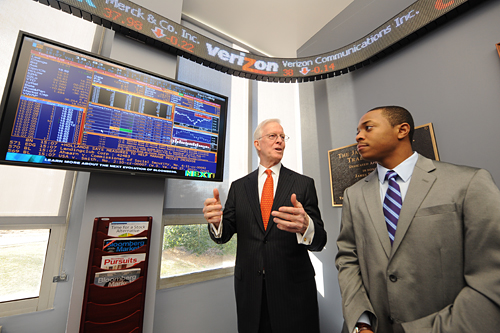
鈥淏ecause I grew up on Long Island, I was looking for a way to give back to some institution on Long Island,鈥� explains Mr. Willumstad, a member of the 茄子视频 Board of Trustees since 2005 and its current chair. 鈥淎delphi has become such an important piece of the economy and the culture, as well as the history, of Nassau County. The students tend to be very local, from Suffolk and Nassau and Queens, and there are a lot of first- and second-generation Americans, which reminds me of how I was 40 years ago. If, through my gift, other kids can get some of the opportunities I had, that would be a terrific thing.鈥�
Mr. Willumstad, the son of a machinist and union representative who later owned a restaurant, grew up in Elmont. He attended Adelphi before a cousin got him an interview for a computer programmer job at Chemical Bank, then one of the largest banks in New York. Mr. Willumstad quickly graduated from programmer to running computer operations to managing entire regions for the retail bank, including Long Island, in the late 1970s.
The skills that made Mr. Willumstad a good programmer helped him excel in business management. 鈥淐omputer programming is a fairly disciplined process of logic and information flow,鈥� he says. 鈥淚n many ways, business is the same. It鈥檚 having the data, doing the analysis and understanding what the problem is. Modern finance, beyond the service aspect, is simply looking for solutions, trying to utilize financing and capital to solve customers鈥� problems.鈥�
In 1986, former colleague Sanford Weill invited Mr. Willumstad to help him build up a relatively small consumer finance company based in Baltimore called Commercial Credit. Intrigued by the opportunity to try something entrepreneurial and have a much larger financial stake in the success and future of a company, Mr. Willumstad joined Mr. Weill and helped him take the company public, then acquire a series of other firms, including financial services company Primerica Corp. and insurance company Travelers. These were exciting days, Mr. Willumstad says: 鈥淚t was always a challenge to smartly acquire companies鈥攎ake sure you鈥檙e paying the right price and that you have a company that will be additive to your business.鈥�
In 1998, the company, now called Travelers Group, merged with Citicorp, the first time an insurance/investment firm had merged with a commercial bank. The deal created the largest financial services company in the world at the time, with $698 billion in assets and operations in 100 countries. Mr. Willumstad was named president of Citigroup Inc. in 2002, adding chief operating officer to his title a year later.
Mr. Willumstad has also seen the consequences of less prudent business decisions up close.聽In June 2008, the board of insurance giant AIG asked Mr. Willumstad, a board member since 2006, to take over from its CEO. The company had lost $13.2 billion in the first six months of 2008. 鈥淚 thought I knew the company well,鈥� Mr. Willumstad told an Adelphi audience in 2009, 鈥渂ut after three weeks of digging and turning over rocks, I realized how fragile AIG鈥檚 balance sheet was.鈥� AIG had allowed its profitable but risky capital markets mortgage business to grow too big, so when that business collapsed, it impacted the whole company, Mr. Willumstad says.
Three months later, the government bailed out AIG with an $85 billion loan, and replaced AIG鈥檚 management with its own leadership team. Mr. Willumstad left the company after only 91 days. His contract entitled him to a $22 million payout, but he turned it down, declining to receive severance payments while shareholders and employees had seen their AIG shares plummet.
While poor risk management got AIG into trouble, Mr. Willumstad believes financial services firms are not the only ones to blame for the financial crisis. 鈥淭he banks made mistakes, but the regulators should have been more aggressive and forceful about dealing with the concentration of risk that was in a lot of these institutions,鈥� he says. 鈥淎nd, at the end of the day, the customers were also responsible, with all of the outrageous amount of debt consumers had, whether it was from credit cards or mortgages. It all fed on each other.鈥�
The global debt crisis continues today, but Mr. Willumstad says the financial services industry is still a place where a hardworking person can learn and make a difference.
鈥淣inety percent of what gets done in financial services is positive,鈥� he says. And these days, he notes, there is a great need for financial services in emerging economies like India, Russia and Brazil, where a relatively low percentage of the population has bank accounts.
That鈥檚 one reason Mr. Willumstad is still in the business himself, investing in consumer-oriented financial services companies in emerging economies, as well as domestic markets, through Brysam. 鈥淭here鈥檚 no middle class without access to capital,鈥� he says. 鈥淚n post-World War II U.S., what drove the middle class was home ownership and loans for cars. Those things don鈥檛 exist in a lot of places. And if there鈥檚 no organized financial system per se, people are more susceptible to being taken advantage of by other lenders.鈥�
This piece appeared in the聽聽Spring 2012 edition.